By Eveline Fondong, MSW
Mental-health and substance-use treatment can change lives. But therapy does not take place in a vacuum.
A person may be working hard to manage depression while worrying about eviction. Someone recovering from alcohol or drug use may have no reliable transportation to appointments. A mother experiencing anxiety may also be struggling to buy food, obtain childcare, or keep the electricity on.
In these situations, counseling remains important—but counseling alone may not address everything affecting the person’s well-being.
That is why connecting people with appropriate social and community services can be an important part of behavioral-health care.
When Life Problems Become Mental-Health Problems
Financial insecurity, unstable housing, unemployment, food insecurity, transportation difficulties, social isolation, and inability to obtain healthcare can create enormous psychological stress.
These challenges may worsen anxiety and depression, contribute to family conflict, and make recovery from substance use more difficult.
Imagine telling someone experiencing homelessness to concentrate on managing stress. Or encouraging someone to attend weekly counseling when that person has no reliable transportation. Good behavioral-health care must recognize these realities.
Sometimes the question is not simply, “What diagnosis does this person have?”
We must also ask, “What is happening in this person’s life that is making recovery more difficult?”
Delaware Shows What Resources May Be Available
Delaware provides a useful example of the kinds of social-service resources that may exist within a state.
Depending upon eligibility and individual circumstances, Delaware residents may have access to programs addressing:
- Food assistance
- Medicaid and healthcare coverage
- Cash assistance
- Childcare assistance
- Emergency and transitional housing
- Utility and energy assistance
- Employment and job-training resources
- Transportation
- Senior services
- Substance-use resources
- Mental-health services
- Legal and other community assistance
For example, Delaware’s Division of Social Services administers or connects residents with programs such as SNAP, Medicaid, childcare assistance, General Assistance, utility assistance, and emergency or transitional housing.
Delaware residents can also use 211, a free and confidential resource-navigation service connecting people with health and human-service organizations throughout the state.
The specific programs and eligibility requirements vary, but the broader lesson applies far beyond Delaware: people may qualify for assistance they do not know exists.
Asking for Help Can Be Complicated
Finding a program is not always the same as successfully accessing it.
Applications may require documentation. Eligibility requirements can be confusing. People may not know which agency to contact. Someone already experiencing depression, trauma, substance use, disability, or severe financial stress may find navigating multiple systems overwhelming.
This is where social-service coordination can become particularly valuable.
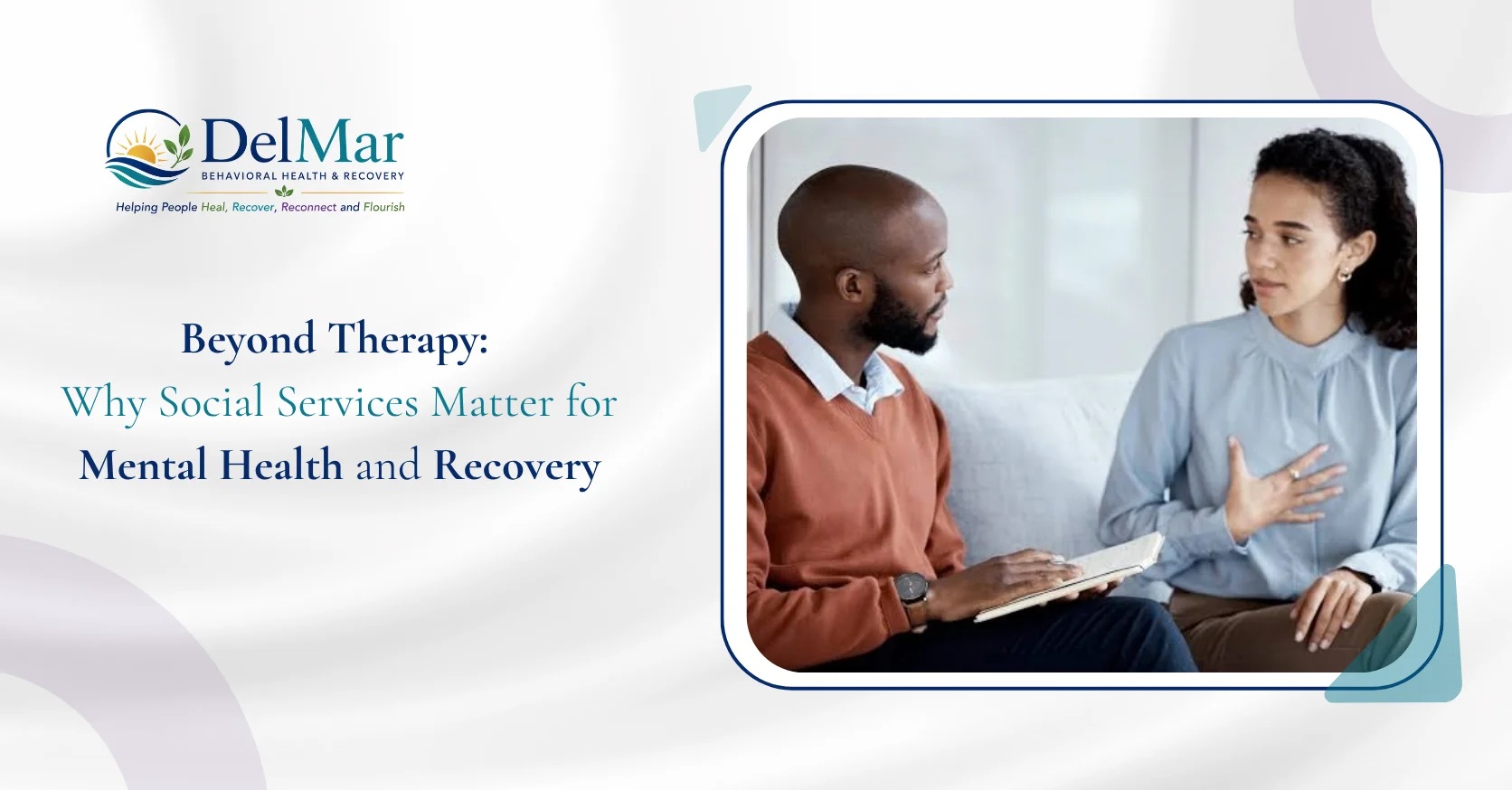
A social-services professional can help identify needs, locate appropriate community resources, explain possible next steps, and support clients as they navigate complicated systems.
The objective is not to create dependency. It is to help people access available resources that may provide enough stability for them to move forward.
Social Stability Can Support Recovery
Behavioral-health recovery is easier when basic needs are reasonably secure.
A safe place to live matters. Food matters. Transportation matters. Healthcare matters. Employment and income matter. Healthy relationships and community support matter.
Addressing these needs does not replace psychotherapy or substance-use treatment. Instead, social services can complement clinical care by addressing practical barriers that interfere with treatment and recovery.
How DelMar Can Help
At DelMar Behavioral Health & Recovery, we believe in caring for the whole person. Behavioral-health concerns may intersect with housing, finances, family circumstances, healthcare access, employment, transportation, food insecurity, and other social needs.
Depending on individual circumstances, location, eligibility, and available community resources, DelMar may help clients:
- Identify social and community-service needs
- Locate food-assistance resources
- Explore housing and emergency-shelter resources
- Identify healthcare and insurance resources
- Locate transportation assistance
- Explore utility-assistance programs
- Identify employment and job-support resources
- Connect with substance-use and recovery resources
- Locate appropriate community and government programs
- Coordinate behavioral-health care with other providers when appropriate
- Obtain referrals to specialized community organizations
- Navigate available resources while continuing mental-health or substance-use treatment
DelMar does not determine eligibility for government benefits and cannot guarantee that a client will qualify for or receive a particular service. Our role is to help clients identify needs, understand available options, and connect with appropriate resources whenever possible.
Let Us Help You Find the Next Step
Sometimes people know they need help but do not know where to begin.
If mental-health or substance-use concerns are occurring alongside housing, financial, family, healthcare, employment, or other social challenges, tell your DelMar provider. Understanding these circumstances can help us develop a more complete picture of your needs.
Contact DelMar Behavioral Health & Recovery to begin the conversation.
Phone: 302-437-6742
Email: contact@delmarbhr.com
Serving clients in Delaware, Maine, Maryland, New Jersey and Texas, with services and resource coordination subject to location, eligibility, availability, professional scope, and applicable requirements.
Sometimes recovery begins with therapy. Sometimes it begins with finding food, housing, healthcare, or transportation. Often, it requires addressing both.
Important Safety Information
This article is provided for general educational and informational purposes only. It does not constitute medical, mental-health, legal, financial, or benefits-eligibility advice. Availability and eligibility requirements for government and community programs vary and may change.
If you or someone else is in immediate danger or experiencing a medical emergency, call 911 or go to the nearest emergency department.
If you are experiencing suicidal thoughts, thoughts of self-harm, or a mental-health crisis, call or text 988 to reach the Suicide & Crisis Lifeline in the United States.
If you are experiencing homelessness, food insecurity, utility problems, domestic violence, or another urgent social need, resources vary by state and community. In Delaware, Delaware 211 connects residents with services including housing, food, healthcare, transportation, utility assistance, mental-health care, substance-use resources, and other assistance.
DelMar Behavioral Health & Recovery does not provide emergency services through its website, email, or routine telephone messaging. Do not use these communication methods for an emergency or time-sensitive crisis.
About the Author
Eveline Fondong, MSW, is a social-work and behavioral-health professional with extensive experience providing social services and support to individuals and families, including people affected by substance-use and behavioral-health challenges.
Her work emphasizes the importance of viewing clients within the broader circumstances of their lives. Mental health and recovery can be influenced by family relationships, housing, financial stability, healthcare access, employment, community resources, and other social factors. At DelMar Behavioral Health & Recovery, Ms. Fondong contributes to behavioral-health services, community outreach, resource coordination, and efforts to connect individuals and families with appropriate social and community supports.