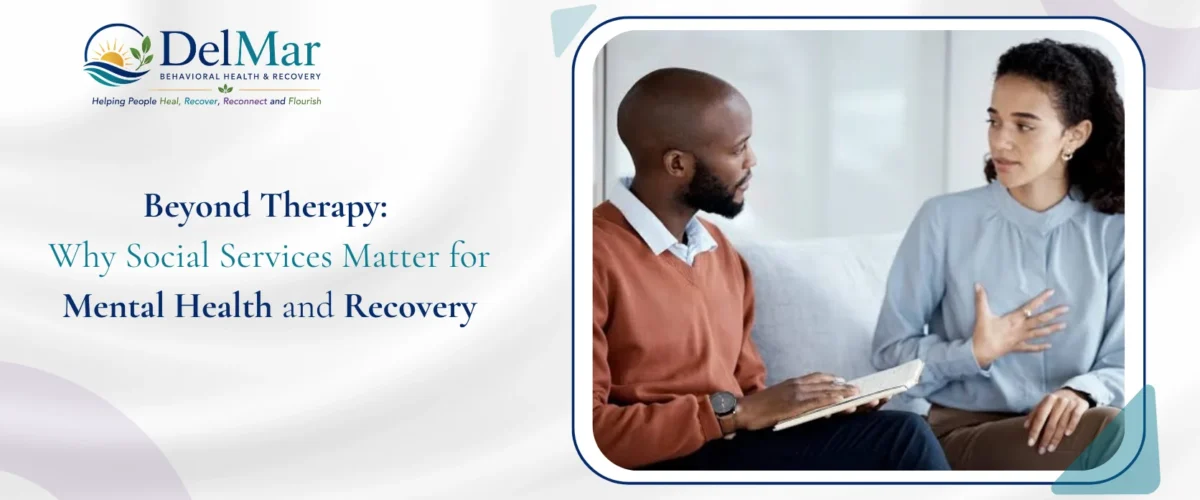
Beyond Therapy: Why Social Services Matter for Mental Health and Recovery

Beyond Therapy: Why Social Services Matter for Mental Health and Recovery

By Eveline Fondong, MSW

Mental-health and substance-use treatment can change lives. But therapy does not take place in a vacuum.
A person may be working hard to manage depression while worrying about eviction. Someone recovering from alcohol or drug use may have no reliable transportation to appointments. A mother experiencing anxiety may also be struggling to buy food, obtain childcare, or keep the electricity on.
In these situations, counseling remains important—but counseling alone may not address everything affecting the person’s well-being.
That is why connecting people with appropriate social and community services can be an important part of behavioral-health care.

When Life Problems Become Mental-Health Problems

Financial insecurity, unstable housing, unemployment, food insecurity, transportation difficulties, social isolation, and inability to obtain healthcare can create enormous psychological stress.
These challenges may worsen anxiety and depression, contribute to family conflict, and make recovery from substance use more difficult.
Imagine telling someone experiencing homelessness to concentrate on managing stress. Or encouraging someone to attend weekly counseling when that person has no reliable transportation. Good behavioral-health care must recognize these realities.
Sometimes the question is not simply, “What diagnosis does this person have?”
We must also ask, “What is happening in this person’s life that is making recovery more difficult?”

Delaware Shows What Resources May Be Available

Delaware provides a useful example of the kinds of social-service resources that may exist within a state.
Depending upon eligibility and individual circumstances, Delaware residents may have access to programs addressing:

  • Food assistance
  • Medicaid and healthcare coverage
  • Cash assistance
  • Childcare assistance
  • Emergency and transitional housing
  • Utility and energy assistance
  • Employment and job-training resources
  • Transportation
  • Senior services
  • Substance-use resources
  • Mental-health services
  • Legal and other community assistance

For example, Delaware’s Division of Social Services administers or connects residents with programs such as SNAP, Medicaid, childcare assistance, General Assistance, utility assistance, and emergency or transitional housing.
Delaware residents can also use 211, a free and confidential resource-navigation service connecting people with health and human-service organizations throughout the state.
The specific programs and eligibility requirements vary, but the broader lesson applies far beyond Delaware: people may qualify for assistance they do not know exists.

Asking for Help Can Be Complicated

Finding a program is not always the same as successfully accessing it.
Applications may require documentation. Eligibility requirements can be confusing. People may not know which agency to contact. Someone already experiencing depression, trauma, substance use, disability, or severe financial stress may find navigating multiple systems overwhelming.
This is where social-service coordination can become particularly valuable.
A social-services professional can help identify needs, locate appropriate community resources, explain possible next steps, and support clients as they navigate complicated systems.
The objective is not to create dependency. It is to help people access available resources that may provide enough stability for them to move forward.

Social Stability Can Support Recovery

Behavioral-health recovery is easier when basic needs are reasonably secure.
A safe place to live matters. Food matters. Transportation matters. Healthcare matters. Employment and income matter. Healthy relationships and community support matter.
Addressing these needs does not replace psychotherapy or substance-use treatment. Instead, social services can complement clinical care by addressing practical barriers that interfere with treatment and recovery.

How DelMar Can Help

At DelMar Behavioral Health & Recovery, we believe in caring for the whole person. Behavioral-health concerns may intersect with housing, finances, family circumstances, healthcare access, employment, transportation, food insecurity, and other social needs.
Depending on individual circumstances, location, eligibility, and available community resources, DelMar may help clients:

  • Identify social and community-service needs
  • Locate food-assistance resources
  • Explore housing and emergency-shelter resources
  • Identify healthcare and insurance resources
  • Locate transportation assistance
  • Explore utility-assistance programs
  • Identify employment and job-support resources
  • Connect with substance-use and recovery resources
  • Locate appropriate community and government programs
  • Coordinate behavioral-health care with other providers when appropriate
  • Obtain referrals to specialized community organizations
  • Navigate available resources while continuing mental-health or substance-use treatment

DelMar does not determine eligibility for government benefits and cannot guarantee that a client will qualify for or receive a particular service. Our role is to help clients identify needs, understand available options, and connect with appropriate resources whenever possible.

Let Us Help You Find the Next Step

Sometimes people know they need help but do not know where to begin.
If mental-health or substance-use concerns are occurring alongside housing, financial, family, healthcare, employment, or other social challenges, tell your DelMar provider. Understanding these circumstances can help us develop a more complete picture of your needs.
Contact DelMar Behavioral Health & Recovery to begin the conversation.

Phone: 302-437-6742
Email: contact@delmarbhr.com

Serving clients in Delaware, Maine, Maryland, New Jersey and Texas, with services and resource coordination subject to location, eligibility, availability, professional scope, and applicable requirements.
Sometimes recovery begins with therapy. Sometimes it begins with finding food, housing, healthcare, or transportation. Often, it requires addressing both.
Important Safety Information
This article is provided for general educational and informational purposes only. It does not constitute medical, mental-health, legal, financial, or benefits-eligibility advice. Availability and eligibility requirements for government and community programs vary and may change.

If you or someone else is in immediate danger or experiencing a medical emergency, call 911 or go to the nearest emergency department.

If you are experiencing suicidal thoughts, thoughts of self-harm, or a mental-health crisis, call or text 988 to reach the Suicide & Crisis Lifeline in the United States.
If you are experiencing homelessness, food insecurity, utility problems, domestic violence, or another urgent social need, resources vary by state and community. In Delaware, Delaware 211 connects residents with services including housing, food, healthcare, transportation, utility assistance, mental-health care, substance-use resources, and other assistance.
DelMar Behavioral Health & Recovery does not provide emergency services through its website, email, or routine telephone messaging. Do not use these communication methods for an emergency or time-sensitive crisis.

About the Author

Eveline Fondong, MSW, is a social-work and behavioral-health professional with extensive experience providing social services and support to individuals and families, including people affected by substance-use and behavioral-health challenges.
Her work emphasizes the importance of viewing clients within the broader circumstances of their lives. Mental health and recovery can be influenced by family relationships, housing, financial stability, healthcare access, employment, community resources, and other social factors. At DelMar Behavioral Health & Recovery, Ms. Fondong contributes to behavioral-health services, community outreach, resource coordination, and efforts to connect individuals and families with appropriate social and community supports.
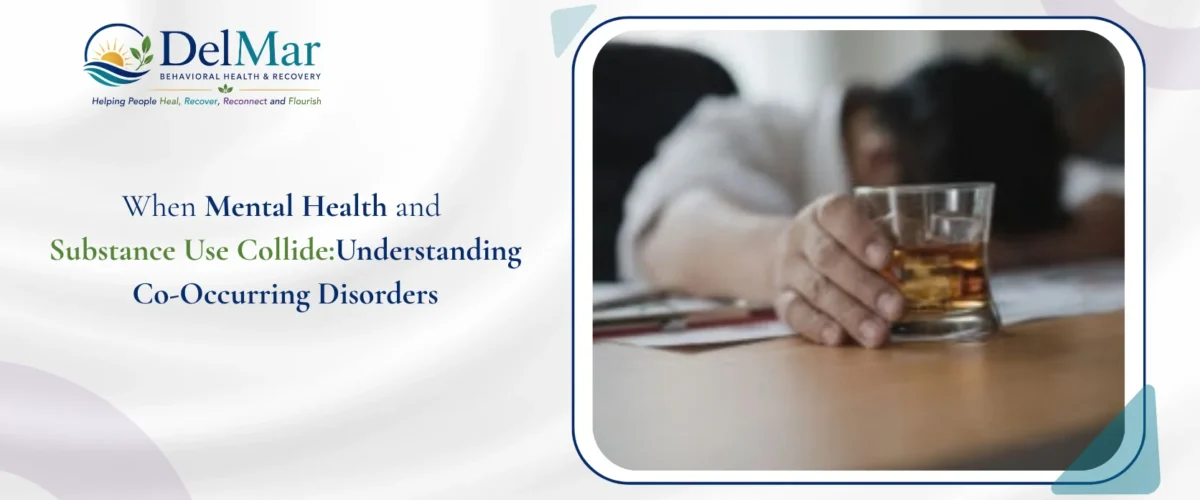
When Mental Health and Substance Use Collide: Understanding Co Occurring Disorders

When Mental Health and Substance Use Collide: Understanding Co-Occurring Disorders

By JJ Asongu, PhD

A person struggling with alcohol or drugs may also be living with depression, anxiety, trauma, or another mental-health concern. Sometimes the substance use begins as an attempt to cope with emotional pain. In other situations, prolonged substance use contributes to or worsens psychological symptoms.

When a mental-health condition and a substance-use disorder occur together, they are commonly described as co-occurring disorders.

Understanding this relationship is important because treating only one problem while overlooking the other may make sustained recovery more difficult.

Which Came First?

Families often ask a seemingly simple question: Did the mental-health problem cause the substance use, or did the substance use cause the mental-health problem?

The answer is not always straightforward.

Someone experiencing anxiety may discover that alcohol temporarily reduces feelings of tension. A person living with trauma may use drugs to escape painful memories. Someone experiencing depression may turn to substances for temporary relief from sadness or emotional emptiness.

But the relationship can also operate in the opposite direction. Alcohol and drug use can contribute to changes in mood, judgment, sleep, relationships, work performance, and overall psychological functioning.

Eventually, it can become difficult to determine where one problem ends and the other begins.

Why Treating Both Matters

Imagine treating someone’s depression without seriously examining heavy alcohol use. Or attempting to address repeated drug use without exploring the trauma, anxiety, grief, or emotional distress that may be contributing to it.

Important parts of the person’s experience may be missed.

Effective treatment therefore requires looking at the whole person rather than simply the most visible symptom.

Common co-occurring concerns may include:

  • Alcohol or drug problems alongside depression
  • Substance use and anxiety
  • Addiction and unresolved trauma
  • Substance use and grief
  • Substance use accompanied by relationship or family difficulties
  • Mental-health concerns complicated by repeated relapse
  • Substance use associated with significant emotional or behavioral problems

Recognizing these connections can help clinicians and clients develop more appropriate treatment plans.

Recovery Requires More Than Stopping the Substance

Reducing or stopping harmful substance use can be essential, but recovery often requires addressing the reasons a person uses substances and the consequences that have developed around that use.

Treatment may therefore involve psychotherapy, substance-use counseling, relapse-prevention strategies, family involvement, behavioral interventions, recovery support, and coordination with medical or psychiatric professionals when appropriate.

For some individuals, medication evaluation may also form part of a broader treatment plan.

The goal is not simply to ask, “How do we stop the drinking or drug use?”

We should also ask: “What is happening in this person’s life, mind, relationships, and environment that needs attention if recovery is going to last?”

How DelMar Can Help

At DelMar Behavioral Health & Recovery, we recognize that mental health, substance use, relationships, and life circumstances are often interconnected.

Depending on individual needs and service availability, DelMar can provide or coordinate:

  • Mental-health assessment and psychotherapy
  • Substance-use counseling
  • Individual counseling
  • Couples and family counseling
  • Treatment for anxiety, depression, trauma, grief, and related concerns
  • Motivational interviewing and behavioral interventions
  • Relapse-prevention planning
  • Recovery-oriented support
  • Telehealth services
  • Coordination with medical, psychiatric, and community providers when appropriate
  • Referral to a higher level of care when clinically necessary

DelMar is also developing expanded outpatient substance-use and recovery services in selected jurisdictions, subject to applicable state authorization.

You Do Not Have to Choose Which Problem to Address First

If you or someone you love is struggling with both substance use and emotional or mental-health difficulties, you do not necessarily have to decide which problem is the “real” problem before seeking help.

A professional assessment can help identify how the different concerns interact and what level and type of treatment may be appropriate.

Contact DelMar Behavioral Health & Recovery to begin the conversation.

Phone: 302-437-6742
Email: contact@delmarbhr.com

Serving clients in Delaware, Maine, Maryland, New Jersey and Texas, with telehealth available where clinically appropriate and legally authorized.

Mental health and substance use can become deeply intertwined. Effective recovery begins by treating the person, not merely the symptom.

Important Safety Information

This article is provided for general educational and informational purposes only. It is not intended to diagnose any condition, establish a therapist-client relationship, or replace individualized medical, psychiatric, substance-use, or mental-health evaluation and treatment.

If you or someone else is in immediate danger, experiencing a medical emergency, has overdosed or may have overdosed, call 911 or go to the nearest emergency department.

If you are experiencing suicidal thoughts, thoughts of self-harm, or a mental-health crisis, call or text 988 to reach the Suicide & Crisis Lifeline in the United States. If there is an immediate threat to life or safety, call 911.

Do not abruptly stop alcohol or other substances when significant physical dependence may be present without appropriate medical guidance. Withdrawal from alcohol and certain drugs can become medically serious or life-threatening. Seek medical evaluation or an appropriate withdrawal-management/detoxification service.

DelMar Behavioral Health & Recovery does not provide emergency services through its website, email, or routine telephone messaging. Do not use these communication methods for an emergency or time-sensitive crisis.

About the Author

JJ Asongu, PhD, is a counselor, psychologist, educator, and behavioral-health professional with experience in psychotherapy, substance-use counseling, behavioral health, and human development. His clinical approach emphasizes understanding the whole person and the interconnected psychological, relational, social, and behavioral factors that influence well-being and recovery.

Dr. Asongu provides counseling services through DelMar Behavioral Health & Recovery and is professionally credentialed to practice under applicable licensure and supervision requirements in Delaware, Maryland, and New Jersey.

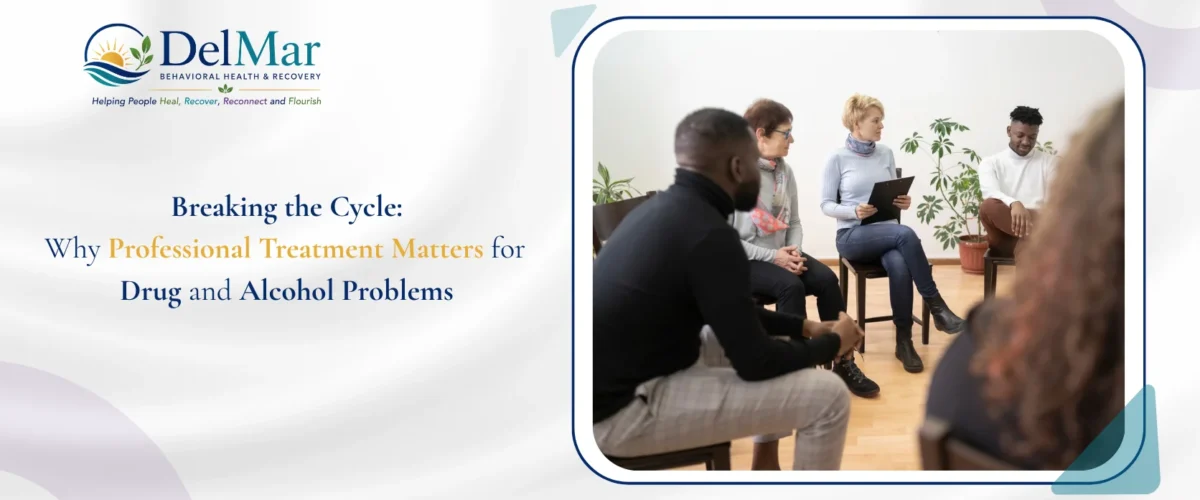
Breaking the Cycle Why Professional Treatment Matters for Drug and Alcohol Problems 1

Breaking the Cycle: Why Professional Treatment Matters for Drug and Alcohol Problems

By George A. Gonzalez, PhD, LMFT-S

Drug and alcohol problems affect individuals, families, relationships, workplaces, and communities. Yet one of the greatest barriers to recovery is the belief that a person should simply be able to stop using through determination or willpower.

Substance-use problems are often far more complicated. They may involve physical dependence, psychological distress, trauma, family and relationship difficulties, environmental pressures, learned behaviors, and powerful patterns of substance use that become increasingly difficult to change without professional help.

For these reasons, seeking treatment should not be viewed as weakness. Recognizing that help is needed can be an important step toward reclaiming one’s health, relationships, stability, dignity, and future.

Substance Use Affects More Than the Individual

Problematic alcohol or drug use rarely affects only the person using the substance. Its consequences may gradually extend into marriage, parenting, employment, finances, friendships, physical health, and emotional well-being.

Families may experience broken promises, mistrust, arguments, financial difficulties, fear, or uncertainty about what will happen next. Spouses and family members may find themselves repeatedly responding to crises or trying to protect their loved one from the consequences of substance use.

Over time, an entire family can begin organizing its life around the substance-use problem.

Treatment therefore involves more than telling someone to “just stop.” Effective recovery requires understanding what sustains the behavior and helping the individual develop healthier ways of coping, relating, making decisions, and living.

Why Professional Treatment Matters

People develop problems with drugs and alcohol for different reasons. Some begin using socially and gradually lose control. Others may use substances to cope with stress, loneliness, trauma, anxiety, depression, grief, relationship problems, or other emotional difficulties.

For still others, genetic, social, environmental, and behavioral factors may interact.

Professional treatment can help identify these underlying issues and develop an individualized plan for recovery.

Depending upon a person’s needs, treatment may include:

  • Individual counseling and psychotherapy
  • Substance-use counseling
  • Motivational interviewing
  • Cognitive and behavioral interventions
  • Couples and family counseling
  • Relapse-prevention planning
  • Recovery-oriented support
  • Case-management and community-resource coordination
  • Treatment for co-occurring mental-health concerns
  • Coordination with medical or psychiatric professionals
  • Referral to detoxification, residential treatment, or another level of care when clinically necessary

No single treatment approach is appropriate for everyone. Good treatment begins by understanding the individual rather than simply treating the substance.

Recovery Is More Than Abstinence

Stopping harmful alcohol or drug use may be an essential goal, but lasting recovery often involves much more.

Recovery may require rebuilding relationships, restoring trust, developing healthier coping strategies, addressing trauma or emotional difficulties, establishing new routines, finding supportive relationships, and rediscovering meaning and purpose.

Relapse can also occur. When it does, it should not automatically be interpreted as proof that treatment has failed. Instead, it may indicate that the treatment and recovery plan needs to be reassessed, strengthened, or adjusted.

The goal is not merely to stop using a substance. The broader goal is to help the individual develop a healthier and more sustainable life.

Do Not Wait for Everything to Fall Apart

People sometimes postpone treatment because they believe their problem is “not bad enough.”

They may say, “I still have my job,” “I have never been arrested,” “My family hasn’t left me,” or “I can stop whenever I want.”

Treatment does not have to begin only after a major crisis.

If alcohol or drugs are interfering with your health, relationships, responsibilities, judgment, finances, emotional well-being, or ability to live the life you want, it may be time to speak with a professional.

Recovery often begins with a difficult but important decision: acknowledging that something needs to change and becoming willing to accept help.

How DelMar Can Help

At DelMar Behavioral Health & Recovery, we understand that substance use rarely exists in isolation. Alcohol and drug problems may be connected to mental health, trauma, relationships, family circumstances, stress, grief, and other challenges.

Depending on individual needs, location, clinical appropriateness, and service availability, DelMar can provide or coordinate:

  • Substance-use counseling
  • Mental-health assessment and psychotherapy
  • Individual counseling
  • Couples and family counseling
  • Treatment for anxiety, depression, trauma, grief, and related concerns
  • Support for co-occurring mental-health and substance-use concerns
  • Motivational interviewing and behavioral interventions
  • Relapse-prevention planning
  • Recovery-oriented support
  • Telehealth services
  • Coordination with medical, psychiatric, and community providers when appropriate
  • Referral to higher levels of care when clinically necessary

DelMar is also developing expanded outpatient substance-use treatment, Intensive Outpatient Program (IOP), and recovery-support services in selected jurisdictions. Services requiring state facility or program licensure will begin only after applicable state authorization has been obtained.

Take the First Step with DelMar

You do not have to face a drug or alcohol problem alone.

Whether you are concerned about your own substance use or worried about someone you love, DelMar Behavioral Health & Recovery can help you explore the next appropriate step.

Contact DelMar today to begin the conversation.

DelMar Behavioral Health & Recovery
Phone: 302-437-6742
Email: contact@delmarbhr.com

Serving clients in Delaware, Maine, Maryland, New Jersey and Texas, with telehealth available where clinically appropriate and legally authorized.

Recovery can begin with one conversation. Contact DelMar and take the first step today.

Important Safety Information

This article is provided for general educational and informational purposes only. It is not intended to diagnose a substance-use disorder or any other condition, establish a therapist-client relationship, or replace individualized medical, psychiatric, substance-use, or mental-health evaluation and treatment.

If you or someone else is in immediate danger, experiencing a medical emergency, has overdosed or may have overdosed, call 911 or go to the nearest emergency department.

If you are experiencing suicidal thoughts, thoughts of self-harm, or a mental-health crisis, call or text 988 to reach the Suicide & Crisis Lifeline in the United States. If there is an immediate threat to life or safety, call 911.

Do not abruptly stop alcohol or other substances when significant physical dependence may be present without appropriate medical guidance. Withdrawal from alcohol and certain drugs can be medically serious and, in some circumstances, life-threatening. Medical evaluation or an appropriate withdrawal-management/detoxification service may be necessary.

DelMar Behavioral Health & Recovery does not provide emergency services through its website, email, or routine telephone messaging. Do not use these communication methods for an emergency or time-sensitive crisis.

About the Author

George A. Gonzalez, PhD, LMFT-S, is an experienced behavioral-health professional whose career in counseling and psychotherapy spans more than three decades. His professional experience includes psychotherapy, marriage and family therapy, addiction counseling, pastoral counseling, clinical supervision, and behavioral-health services.

Dr. Gonzalez is a Licensed Marriage and Family Therapist-Supervisor (LMFT-S) in Texas, License No. 2630. He also holds multiple professional credentials in Maine, including Clinical Professional Counselor (CC342), Professional Counselor (PC466), Marriage & Family Therapist (MF467), and Pastoral Counselor (LP269).

His clinical work reflects an integrated approach to behavioral health that recognizes the connections among substance use, mental health, relationships, family systems, personal values, and the broader circumstances of a person’s life.

Dr. Gonzalez provides behavioral-health services through DelMar Behavioral Health & Recovery within the scope of his applicable professional licenses and credentials.

When Love Is Not Enough: Why Couples Sometimes Need Professional Help

When Love Is Not Enough: Why Couples Sometimes Need Professional Help

By JJ Asongu, PhD

Marriage and long-term relationships can be among the most meaningful experiences of our lives. They can provide companionship, intimacy, emotional security, shared purpose, and a foundation for family life. But love alone does not guarantee that two people will always know how to communicate, resolve conflict, rebuild trust, or navigate major changes together.

When relationships become difficult, many couples first turn to family, friends, religious communities, or spiritual leaders for guidance. These sources of support can be invaluable. Yet there are times when they may not be enough—and, in some circumstances, family or religion may itself be part of the conflict.

This is when consulting a qualified marriage or couples therapist can be especially helpful.

Family Can Support You, but Family Is Rarely Neutral

Family members usually want what is best for us. However, emotional attachment can make objectivity difficult.

Parents may instinctively defend their own child. Siblings may interpret a disagreement through years of family history. Friends may hear only one partner’s version of events. After a couple reconciles, relatives may continue carrying anger or resentment about things disclosed during the crisis.

Professional therapy provides something different: a confidential and structured environment in which both partners can be heard and patterns affecting the relationship can be explored.

A couples therapist is not there simply to decide who is right or wrong. Therapy can help partners understand how they communicate, how conflicts develop, what each person needs from the relationship, and what changes may be necessary.

Religion Can Be a Source of Strength—and Sometimes Conflict

For many couples, religion provides meaning, moral guidance, community, hope, and resources for forgiveness and reconciliation. Religious and spiritual leaders can therefore play an important role in supporting couples experiencing difficulties.

However, religious guidance and professional psychotherapy serve different purposes.

Religion itself can also become an area of disagreement. Partners may belong to different religious traditions, disagree about religious practices, experience changes in belief, or disagree about how children should be raised. Conflict may also develop around expectations concerning marriage, sexuality, gender roles, divorce, finances, or relationships with extended family.

In other situations, religious or cultural expectations may make a spouse reluctant to discuss serious marital problems or seek outside assistance.

A skilled therapist can help couples explore these concerns respectfully without requiring either partner to abandon deeply held beliefs. When clients desire it, therapy can also respectfully incorporate their religious or spiritual values.

Do Not Wait Until Divorce Seems Inevitable

Couples therapy should not be viewed only as the final stop before separation or divorce.

Consider seeking professional help when:

  • The same arguments occur repeatedly without resolution
  • Communication has become hostile, defensive, or nonexistent
  • Emotional or physical intimacy has significantly declined
  • Trust has been damaged
  • Infidelity or betrayal has affected the relationship
  • Parenting, finances, religion, or extended family repeatedly cause conflict
  • Substance use or mental-health concerns are affecting the relationship
  • One or both partners feel lonely within the relationship
  • Separation or divorce is being seriously considered

Earlier intervention may give couples more opportunities to understand what is happening before resentment and emotional distance become deeply entrenched.

Professional Help Can Complement Your Existing Support System

Seeking therapy does not mean rejecting your family, culture, community, or religion.

Couples can continue drawing strength from these resources while also benefiting from professional counseling.

Couples therapy can help partners:

  • Identify unhealthy communication patterns
  • Learn more constructive ways to manage disagreements
  • Understand each other’s emotional needs
  • Rebuild trust following betrayal or conflict
  • Establish healthier boundaries
  • Address intimacy and relationship concerns
  • Navigate parenting and blended-family challenges
  • Address the impact of mental-health or substance-use concerns
  • Explore religious, cultural, or value differences
  • Make thoughtful decisions about the future of the relationship

Sometimes the most useful question is not simply, “Who is right?” but rather, “What is happening between us, and how can we change it?”

A trained couples therapist can help partners begin answering that question together.

How DelMar Can Help

At DelMar Behavioral Health & Recovery, we recognize that relationship problems rarely occur in isolation. Marital conflict may intersect with stress, anxiety, depression, trauma, grief, substance use, parenting challenges, financial pressures, cultural differences, religious concerns, and major life transitions.

Depending on individual needs, location, clinical appropriateness, and service availability, DelMar can provide or coordinate:

  • Couples and relationship counseling
  • Marriage counseling
  • Family counseling
  • Individual psychotherapy
  • Communication and conflict-resolution support
  • Counseling related to trust and relationship repair
  • Parenting and family-related counseling
  • Mental-health counseling
  • Substance-use counseling
  • Faith-integrated counseling for clients who request it
  • Telehealth services
  • Coordination with other behavioral-health or medical professionals when appropriate
  • Referral to specialized or higher levels of care when clinically necessary

Our goal is not to impose a predetermined outcome on a relationship. Rather, therapy provides a professional environment in which couples can better understand their difficulties, develop healthier ways of relating, and make informed decisions about their future.

Take the First Step with DelMar

You do not have to wait until your relationship reaches a crisis before seeking help.

Whether you are struggling with communication, trust, intimacy, recurring conflict, family pressures, religious differences, or uncertainty about the future of your relationship, DelMar Behavioral Health & Recovery can help you explore the next appropriate step.

Contact DelMar today to begin the conversation.

DelMar Behavioral Health & Recovery
Phone: 302-437-6742
Email: contact@delmarbhr.com

Serving clients in Delaware, Maine, Maryland, New Jersey and Texas, with telehealth available where clinically appropriate and legally authorized.

Seeking professional help does not necessarily mean that your relationship is ending. Sometimes asking for help is one of the most important ways of showing that the relationship is worth understanding, protecting, and rebuilding.

Important Safety Information

This article is provided for general educational and informational purposes only. It does not constitute a diagnosis, individualized mental-health advice, legal advice, or a substitute for professional assessment and treatment. Reading this article or contacting DelMar through its website does not by itself establish a therapist-client relationship.

Couples counseling may not always be appropriate when there is active domestic violence, coercive control, threats, stalking, intimidation, or fear for personal safety. In such circumstances, safety should take priority, and an individual assessment may be appropriate before couples therapy is considered.

If you or someone else is in immediate danger, call 911 or go to a safe location when possible.

If you are experiencing suicidal thoughts, thoughts of self-harm, or a mental-health crisis, call or text 988 to reach the Suicide & Crisis Lifeline in the United States. If there is an immediate threat to life or safety, call 911.

DelMar Behavioral Health & Recovery does not provide emergency services through its website, email, or routine telephone messaging. Do not use these communication methods for an emergency or time-sensitive crisis.

About the Author

JJ Asongu, PhD, LGPC, LACMH, is a counselor, psychologist, educator, and behavioral-health professional whose work integrates psychological, relational, behavioral, and social dimensions of human well-being. His clinical interests include individual psychotherapy, couples and family counseling, substance-use counseling, co-occurring mental-health concerns, and the relationship between personal values, meaning, relationships, and psychological health.

Dr. Asongu is a Licensed Associate Counselor of Mental Health (LACMH) in Delaware and a Licensed Graduate Professional Counselor (LGPC) in Maryland, where he practices under applicable clinical supervision requirements. He is also pursuing authorization to practice as a Licensed Associate Counselor in New Jersey.

Through DelMar Behavioral Health & Recovery, Dr. Asongu provides counseling and behavioral-health services within the scope of his applicable professional credentials, licensure, and supervision.